Table of Contents
1. Introduction
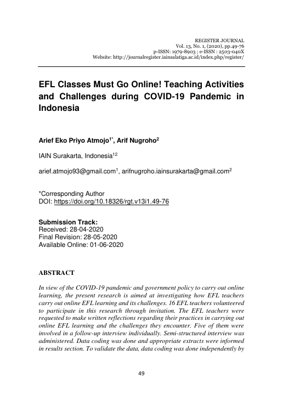
The COVID-19 pandemic forced a global shift to online education. In Indonesia, the Ministry of Education mandated online learning from March 2020. This study by Atmojo and Nugroho (2020) investigates how EFL teachers adapted, focusing on teaching activities and challenges. The research highlights the lack of preparation and the digital divide, offering critical insights for future crisis pedagogy.
2. Research Methodology
2.1 Participants and Data Collection
16 EFL teachers from various schools in Indonesia participated via invitation. They wrote reflections on their online teaching practices and challenges. Five teachers were selected for follow-up semi-structured interviews.
2.2 Data Analysis
Data coding was performed independently by both researchers, followed by iterative discussions to ensure validity. Thematic analysis was used to identify key patterns.
3. Findings: Online Teaching Activities
3.1 Synchronous vs Asynchronous Learning
Teachers employed both synchronous (e.g., live video classes) and asynchronous (e.g., recorded videos, assignments) methods, depending on school policy and internet access.
3.2 Platforms and Tools Used
Common platforms included Learning Management Systems (LMS) like Google Classroom, WhatsApp for communication, and additional resources like YouTube and Zoom.
4. Challenges Encountered
4.1 Student-Related Challenges
Students faced lack of devices, poor internet connectivity, low motivation, and difficulty understanding materials independently.
4.2 Teacher-Related Challenges
Teachers struggled with limited digital literacy, time management, and adapting materials for online delivery.
4.3 Parent-Related Challenges
Parents were often unable to support learning due to work commitments or lack of technological knowledge.
5. Statistical Overview
16
EFL Teachers
5
In-depth Interviews
2020
Study Year
6. Key Insights
- Lack of Preparation: The sudden shift exposed the absence of prior online teaching training.
- Digital Divide: Unequal access to technology hindered equitable learning.
- Teacher Resilience: Despite challenges, teachers showed adaptability and creativity.
- Need for Policy Support: Structured guidelines and infrastructure investment are essential.
7. Original Analysis
This study underscores a critical gap in crisis-preparedness within educational systems. While the rapid pivot to online learning was necessary, the findings reveal that technology integration without pedagogical alignment leads to superficial engagement. As noted by Hodges et al. (2020) in their seminal work on emergency remote teaching, the difference between planned online learning and crisis-driven instruction is profound. The Indonesian EFL context mirrors global patterns: teachers became content deliverers rather than facilitators, and students became passive recipients. A key technical contribution is the identification of a multi-stakeholder challenge matrix (students, teachers, parents), which can inform future frameworks. For instance, the Technology Acceptance Model (TAM) (Davis, 1989) could be extended to include crisis factors. Personal insight: the study's reliance on self-reported reflections limits generalizability, but its qualitative depth provides rich contextual understanding. Future research should incorporate quantitative measures of learning outcomes and longitudinal tracking of teacher skill development.
8. Technical Details and Mathematical Framework
The study implicitly uses a thematic analysis framework. A mathematical representation of the challenge severity can be modeled as:
$C_{total} = \sum_{i=1}^{n} (w_i \cdot c_i)$
Where $C_{total}$ is the total challenge score, $w_i$ is the weight of challenge category $i$, and $c_i$ is the frequency count of that challenge. For example, if student-related challenges ($c_1$) have weight $w_1 = 0.5$ and frequency 10, teacher-related ($c_2$) weight $w_2 = 0.3$ frequency 8, parent-related ($c_3$) weight $w_3 = 0.2$ frequency 5, then $C_{total} = 0.5 \cdot 10 + 0.3 \cdot 8 + 0.2 \cdot 5 = 5 + 2.4 + 1 = 8.4$.
9. Experimental Results and Diagram Description
Diagram: Challenge Distribution Pie Chart
Description: A pie chart showing the proportion of challenges reported by teachers. Student-related challenges account for 50% (e.g., lack of devices, connectivity), teacher-related 30% (e.g., digital literacy, time), and parent-related 20% (e.g., inability to assist). This visualizes the primary bottleneck in student readiness.
10. Analysis Framework Example
Case Study: Teacher A's Online Lesson
Teacher A used WhatsApp to send daily assignments and YouTube links. Students submitted photos of handwritten work. Challenges: 70% of students had smartphones but only 40% had stable internet. Teacher A spent 2 hours daily on individual feedback. This case illustrates the 'low-tech' adaptation common in resource-constrained settings.
11. Future Applications and Directions
- Blended Learning Models: Post-pandemic, hybrid approaches combining online and offline can be optimized.
- Teacher Training: Pre-service and in-service programs must include digital pedagogy.
- Infrastructure Investment: Government and private sector collaboration to provide devices and internet access.
- AI-Powered Tools: Adaptive learning platforms can personalize instruction and reduce teacher workload.
12. References
- Atmojo, A. E. P., & Nugroho, A. (2020). EFL Classes Must Go Online! Teaching Activities and Challenges during COVID-19 Pandemic in Indonesia. Register Journal, 13(1), 49-76.
- Davis, F. D. (1989). Perceived usefulness, perceived ease of use, and user acceptance of information technology. MIS Quarterly, 13(3), 319-340.
- Hodges, C., Moore, S., Lockee, B., Trust, T., & Bond, A. (2020). The difference between emergency remote teaching and online learning. Educause Review, 27.
- McAleer, M. (2020). Prevention is better than the cure: Risk management of COVID-19. Journal of Risk and Financial Management, 13(3), 46.