Table of Contents
1. Introduction & Background
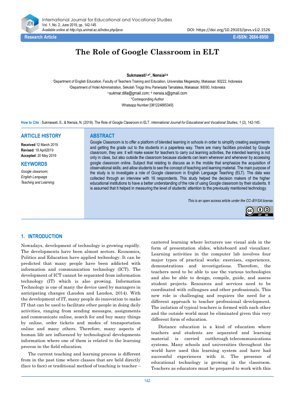
This study investigates the integration of Google Classroom within English Language Teaching (ELT), positioned against the backdrop of rapid technological advancement. The research acknowledges the pervasive influence of Information and Communication Technology (ICT) across all sectors, including education, necessitating a pedagogical evolution.
1.1 The ICT Revolution in Education
Information Technology (IT) is framed as a critical tool for managing and anticipating change (Laudon & Laudon, 2014). Its development has spurred innovations that facilitate daily activities—communication, commerce, and notably, education. The learning process is now fundamentally influenced by these technological developments, moving beyond the confines of traditional classrooms.
1.2 The Shift from Traditional to Blended Learning
The paper contrasts past teacher-centered, face-to-face instruction—reliant on slides and whiteboards—with contemporary demands. It highlights the emergence of distance education, where teachers and students are separated, connected via telecommunications systems. This shift demands that educators acquire new competencies to design, guide, and assess learning in technology-mediated environments, breaking down the traditional isolation of the teaching profession.
2. Google Classroom in ELT: Core Functions & Facilities
Google Classroom is presented as a blended learning platform designed to streamline assignment creation, distribution, and grading in a paperless manner.
2.1 Platform Overview and Key Features
The primary purpose of Google Classroom in this context is to simplify administrative tasks for teachers and create a centralized hub for learning resources and communication.
2.2 Facilitating Paperless and Flexible Learning
The study identifies several key facilities: enhancing the ease of conducting learning activities, and extending learning beyond physical classrooms. It enables "learning wherever and whenever" through online access, supports the acquisition of observational skills via mobile learning, and aids in visualizing teaching concepts.
3. Research Methodology & Data Collection
The study employs a qualitative approach to understand the role of Google Classroom from the users' perspective.
3.1 Study Design and Respondent Profile
Data was collected through interviews with 16 respondents. The paper states the study aims to help decision-makers in higher education understand student usage patterns and measure the level of student attention to this technology.
3.2 Data Analysis Framework
While specific analytical methods are not detailed in the provided excerpt, the research is positioned as investigative, seeking to elucidate the practical role and perceived impact of the platform in an ELT context.
4. Results, Discussion & Key Findings
The findings, implied through the introduction's framing, suggest several outcomes related to the adoption of Google Classroom.
4.1 Impact on Teaching and Learning Activities
The platform is posited to make learning activities easier for teachers to manage and execute, shifting some logistical burdens and enabling more efficient workflow.
4.2 Student Engagement and Accessibility
A major finding is the breaking of spatiotemporal barriers to learning. By providing constant online access, it promotes flexibility and supports self-paced learning, which is crucial for language acquisition that benefits from consistent exposure and practice.
Research Scope at a Glance
Method: Qualitative Interviews
Respondents: 16
Core Focus: Role & Perception of Google Classroom in ELT
Key Outcome: Informing Institutional Decision-Makers
5. Technical Framework & Analytical Model
While the PDF does not present complex mathematical models, the effectiveness of a platform like Google Classroom can be conceptualized through an adoption and impact framework. We can model the perceived utility (U) for a teacher as a function of reduced administrative overhead (A), increased student engagement (E), and flexibility (F), offset by the learning curve (L) and technological barriers (B).
$U_{teacher} = \frac{(\alpha A + \beta E + \gamma F)}{(\delta L + \epsilon B)}$
Where $\alpha, \beta, \gamma$ are positive weights for benefits, and $\delta, \epsilon$ are weights for costs. Successful integration occurs when $U > 1$. This aligns with models from technology acceptance literature like TAM (Technology Acceptance Model), which posits that perceived usefulness and ease of use drive adoption (Davis, 1989).
Analysis Framework Example Case: Evaluating Platform Efficacy
Scenario: An ELT department wants to evaluate if Google Classroom improves homework submission rates.
- Define Metrics: Baseline submission rate (pre-implementation), submission rate after 3 months, student survey on platform usability.
- Data Collection: Use Classroom's built-in activity logs for submission data. Distribute a short Likert-scale survey.
- Analysis: Perform a paired t-test to compare pre/post submission rates. Analyze survey data for correlation between usability scores and individual student submission improvement.
- Interpretation: A statistically significant increase in submission rates, coupled with positive usability feedback, indicates successful efficacy in this specific task.
6. Industry Analyst's Perspective
This study, while limited in scope, serves as a critical microcosm of the massive, often clumsy, digitization of global education. Let's dissect it with clear eyes.
6.1 Core Insight
This isn't a study about Google Classroom's features; it's a document capturing the necessary but superficial first step in EdTech adoption: justifying the replacement of paper with a cloud-based workflow. The real thesis is that institutions are scrambling to catch up to student realities, using tools like Classroom as a digital plaster over a fundamentally outdated pedagogical model. The reference to Laudon & Laudon (2014) on IT managing change is ironically apt—the change being managed here is often institutional inertia, not pedagogical innovation.
6.2 Logical Flow
The argument follows a safe, well-trodden path: Technology is everywhere (inevitable) → Education must adapt (imperative) → Here is a popular tool (solution) → Let's see what users think (validation). It mirrors the Gartner Hype Cycle's "Peak of Inflated Expectations" phase for LMS tools in developing educational contexts. The flow prioritizes adoption justification over critical examination of learning outcomes. It asks "Does it work?" in a logistical sense, not "How does it transform learning?"
6.3 Strengths & Flaws
Strengths: It correctly identifies the breaking of spatiotemporal barriers as the killer feature—this is the non-negotiable value proposition of any modern LMS. Focusing on ELT is smart, as language learning benefits immensely from asynchronous practice and resource access. Interviewing 16 users provides qualitative texture that pure analytics lack.
Glaring Flaws: The sample size (n=16) is anecdotal, not conclusive. There's no mention of control groups, learning outcome comparisons (e.g., test scores vs. traditional classes), or longitudinal data. The "level of students’ attention" is a vague, almost unmeasurable metric without operational definition—are they measuring click-through rates or cognitive engagement? It conflates use with utility. Most damningly, it overlooks the "Google Elephant in the Room": data privacy, platform lock-in, and the commodification of student attention within a corporate ecosystem, issues heavily debated in reports from institutions like The Center for Democracy & Technology.
6.4 Actionable Insights
For decision-makers, this study should be a starting pistol, not a finish line. First, mandate paired evaluation: track not just adoption metrics, but hard learning outcomes and student well-being data (digital fatigue, anxiety). Second, invest in teacher PD that goes beyond buttonology—train them to design for the platform, using its features to enable collaborative projects, peer review, and flipped classrooms, not just PDF distribution. Third, develop an institutional EdTech ethics charter addressing data privacy, accessibility, and alternative tools to avoid vendor monoculture. The goal isn't to use Google Classroom; it's to use it well and wisely as one tool among many to achieve superior pedagogical ends.
7. Future Applications & Research Directions
The future of tools like Google Classroom in ELT lies not in incremental feature updates, but in deeper, more intelligent integration.
- AI-Powered Personalization: Future iterations could leverage AI (similar to adaptive learning pathways in platforms like Duolingo or Khan Academy) to analyze student writing and error patterns within submitted assignments, providing automated, formative feedback on grammar and syntax, freeing teachers for higher-order tutoring.
- Immersive & Experiential Learning Hubs: The platform could evolve from a content repository into a portal for Virtual Reality (VR) language immersion scenarios or link to external simulation tools, moving beyond text and video to experiential practice.
- Learning Analytics Dashboards: Advanced analytics, moving beyond simple submission rates to visualize individual and cohort proficiency trends, engagement hotspots, and predictive alerts for at-risk students, providing teachers with actionable intelligence.
- Interoperability & Decentralization: A critical research direction is exploring integration with other specialized tools (e.g., speech recognition for pronunciation, peer review platforms) via standards like LTI (Learning Tools Interoperability), preventing platform lock-in and creating a "best-of-breed" ecosystem.
- Research Imperatives: Future studies must employ mixed-methods, longitudinal designs with larger samples. They should directly correlate platform usage metrics with standardized language proficiency gains and investigate the socio-technical implications of pervasive EdTech, including digital equity and educator autonomy.
8. References
- Davis, F. D. (1989). Perceived Usefulness, Perceived Ease of Use, and User Acceptance of Information Technology. MIS Quarterly, 13(3), 319–340.
- Laudon, K. C., & Laudon, J. P. (2014). Management Information Systems: Managing the Digital Firm. Pearson.
- Sukmawati, S., & Nensia, N. (2019). The Role of Google Classroom in ELT. International Journal for Educational and Vocational Studies, 1(2), 142–145.
- Center for Democracy & Technology. (2023). Student Privacy in the Digital Age. Retrieved from https://cdt.org
- Zhu, J., Park, T., Isola, P., & Efros, A. A. (2017). Unpaired Image-to-Image Translation using Cycle-Consistent Adversarial Networks. Proceedings of the IEEE International Conference on Computer Vision (ICCV). (Cited as an example of a transformative technical framework—CycleGAN—which redefined its field, unlike the incremental adoption discussed in the PDF).