1. Introduction
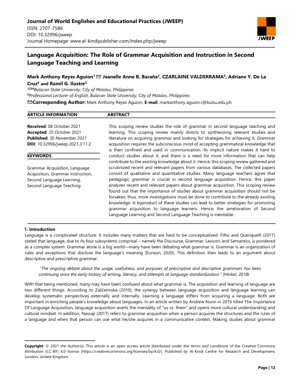
This scoping review investigates the pivotal role of grammar within the domain of second language (L2) teaching and learning. Language, characterized as a complex system comprising discourse, grammar, lexicon, and semantics, presents significant challenges for L2 learners. Grammar, specifically, involves the subconscious acquisition of structural rules and their application in communicative contexts. Despite its fundamental importance, empirical research on grammar acquisition has historically received less attention compared to other language skills. This paper synthesizes recent qualitative and quantitative studies to elucidate effective strategies for promoting grammar acquisition, ultimately aiming to enhance both L2 learning and teaching methodologies.
2. Literature Review
The review establishes the theoretical foundation by examining key debates and definitions central to grammar acquisition in L2 contexts.
2.1 Defining Grammar Acquisition
Grammar acquisition is distinguished from language learning. Acquisition refers to the subconscious internalization of grammatical knowledge, enabling its use in spontaneous communication (Nassaji, 2017). This contrasts with conscious learning of rules. The paper engages with the longstanding debate between descriptive grammar (how language is actually used) and prescriptive grammar (how it "ought" to be used), a tension highlighted by Hinkel (2018).
2.2 Historical Context of Grammar Research
While language learning research proliferated from the 1970s, investigations into grammar acquisition and learning strategies were often marginalized (Anderson, 2005; Pawlak, 2009; Park & Lee, 2007). This created a significant gap in understanding the most effective ways to facilitate the implicit process of acquisition within formal instructional settings.
2.3 Pedagogical Grammar Approaches
The consensus among language teachers is that pedagogic grammar—grammar tailored for teaching—is crucial. However, the optimal method for integrating it into instruction to foster acquisition, rather than mere rule memorization, remains a core question addressed by this review.
3. Methodology
This study employs a scoping review methodology to map the existing literature.
3.1 Scoping Review Framework
The framework follows established protocols for identifying, selecting, and synthesizing existing research to clarify key concepts and evidence gaps.
3.2 Data Collection & Analysis
Recent and relevant papers were gathered from various academic databases. The corpus included both qualitative and quantitative studies, which were then scrutinized to identify common themes, effective strategies, and unresolved questions regarding grammar acquisition.
4. Key Findings
The synthesis of literature reveals several critical insights into the nature and facilitation of grammar acquisition.
4.1 Implicit vs. Explicit Learning
A central finding is the recognition of grammar acquisition's implicit nature. Effective instruction must create conditions that promote subconscious pattern recognition, moving beyond explicit rule explanation. The challenge lies in designing classroom activities that trigger this implicit learning mechanism.
4.2 Effective Instructional Strategies
The review suggests that strategies integrating grammar within meaningful, communicative tasks are more conducive to acquisition than isolated drills. This aligns with task-based language teaching (TBLT) principles, where grammatical forms are addressed as needed to complete communicative objectives.
4.3 Research Gaps Identified
The paper concludes that despite its importance, empirical research on grammar acquisition remains insufficient. There is a pressing need for more classroom-based studies that investigate the longitudinal effects of different instructional interventions on the acquisition process.
5. Technical Analysis & Framework
Core Insight: The paper's fundamental, yet under-explored, argument is that the L2 teaching industry has been operating on a flawed premise: treating grammar as a content domain to be taught, rather than a cognitive process to be acquired. The real bottleneck isn't pedagogical knowledge but the lack of a robust, measurable framework for the implicit acquisition process itself.
Logical Flow: The review correctly identifies the historical neglect of grammar acquisition research, synthesizes the implicit/explicit learning dichotomy, and calls for more empirical work. However, its logic stalls at the point of actionable intervention. It highlights the "what" (acquisition is important) and the "why" (it's under-researched) but offers little on the "how" of measuring or engineering it in a classroom.
Strengths & Flaws: Its strength is a clear, sobering diagnosis of the research gap. Its critical flaw is the lack of a proposed technical or methodological framework to bridge that gap. Contrast this with computational fields. In machine translation, progress was revolutionized by moving from rule-based systems (analogous to prescriptive grammar teaching) to statistical and neural models that "acquire" language patterns from massive data corpora, often evaluated through metrics like BLEU score $\text{BLEU} = BP \cdot \exp(\sum_{n=1}^{N} w_n \log p_n)$. L2 acquisition research lacks an equivalent to the BLEU score—a reliable, quantitative metric for acquisition depth beyond grammaticality judgments.
Actionable Insights: The field must pivot. First, adopt methodologies from cognitive science and computational linguistics to model the acquisition process. Techniques like priming experiments or eye-tracking during reading can quantify implicit knowledge. Second, develop adaptive learning systems. Inspired by personalized recommendation algorithms, these systems could present grammatical structures based on a learner's current interlanguage, optimizing for the "zone of proximal development." The formula for item presentation could be based on a difficulty function $D(i) = f(\text{frequency}, \text{structural complexity}, \text{L1-L2 distance})$, ensuring optimal input for acquisition. The future of grammar instruction lies not in better textbooks, but in data-driven, personalized acquisition engines.
Analysis Framework Example: Consider a non-code based framework for evaluating an instructional activity's potential for promoting acquisition:
- Input Quality: Is the target structure embedded in comprehensible, meaningful input? (Yes/No)
- Processing Focus: Does the task require learners to process the structure for meaning, not form? (Yes/No)
- Output Opportunity: Does it create a genuine need for the learner to use the structure to communicate? (Yes/No)
- Feedback Type: Is corrective feedback provided implicitly (e.g., recasts) rather than explicitly? (Yes/No)
6. Future Applications & Directions
The path forward requires interdisciplinary convergence and technological integration.
- AI-Powered Personalized Tutors: Leveraging large language models (LLMs) to generate infinite, level-appropriate communicative scenarios targeting specific grammatical features, providing implicit feedback through natural conversation.
- Neurolinguistic Monitoring: Using affordable, non-invasive tools like EEG or fNIRS in classroom research to directly observe brain activity associated with implicit grammar processing, moving beyond behavioral data.
- Gamified Acquisition Environments: Developing immersive VR/AR simulations where grammar acquisition is a byproduct of solving problems and interacting in a virtual world, applying principles from game-based learning.
- Cross-Linguistic Database: Creating a large-scale, open database of learner interlanguage samples tagged for grammatical features, enabling data-mining to discover universal acquisition sequences and L1-specific challenges.
The ultimate goal is to shift from a teaching-centric to an acquisition-centric paradigm, where technology and research provide a detailed map of the learner's internal grammatical system and the optimal pathways to develop it.
7. References
- Aguion, M. A. R., Baraña, J. A. B., Valderrama, C., De La Cruz, A. Y., & Ilustre, R. G. (2021). Language Acquisition: The Role of Grammar Acquisition and Instruction in Second Language Teaching and Learning. Journal of World Englishes and Educational Practices (JWEEP), 3(11), 12-19.
- Hinkel, E. (2018). Teaching grammar in second language classrooms. In The Routledge Handbook of Teaching English (pp. 205-220). Routledge.
- Nassaji, H. (2017). Grammar acquisition. In The Routledge Handbook of Instructed Second Language Acquisition (pp. 205-223). Routledge.
- Park, G., & Lee, H. (2007). The characteristics of effective English grammar instruction. English Teaching, 62(1), 201-222.
- Papineni, K., Roukos, S., Ward, T., & Zhu, W. J. (2002). BLEU: a method for automatic evaluation of machine translation. Proceedings of the 40th Annual Meeting of the Association for Computational Linguistics (ACL) (pp. 311-318).
- Ellis, R. (2006). Current issues in the teaching of grammar: An SLA perspective. TESOL Quarterly, 40(1), 83-107.
- Norris, J. M., & Ortega, L. (2000). Effectiveness of L2 instruction: A research synthesis and quantitative meta-analysis. Language Learning, 50(3), 417-528.