Table of Contents
- 1. Introduction
- 2. Reading Comprehension: Definition and Importance
- 3. Levels of Reading Comprehension Ability
- 4. The Comprehension Ability Test (CAT)
- 5. Technical Details and Mathematical Formulation
- 6. Experimental Results and Diagram Description
- 7. Analysis Framework Example
- 8. Core Insight, Logical Flow, Strengths & Flaws, Actionable Insights
- 9. Original Analysis
- 10. Future Applications and Outlook
- 11. References
1. Introduction
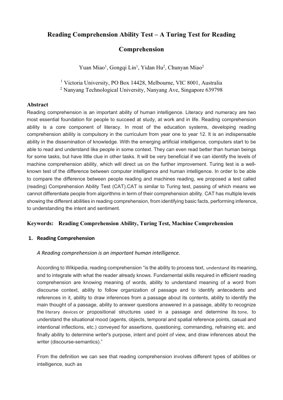
Reading comprehension is a cornerstone of human intelligence, essential for learning, work, and daily life. As artificial intelligence (AI) systems increasingly demonstrate the ability to process and understand text, the need to systematically evaluate machine comprehension becomes critical. This paper introduces the Comprehension Ability Test (CAT), a novel framework inspired by the Turing Test, designed to compare human and machine reading comprehension across multiple levels of complexity. CAT aims to identify not just whether a machine can read, but how well it understands, infers, and interprets text, providing a benchmark for AI development.
2. Reading Comprehension: Definition and Importance
According to Wikipedia, reading comprehension is "the ability to process text, understand its meaning, and to integrate with what the reader already knows." This definition encompasses a range of cognitive skills, from basic word recognition to complex inference and intent analysis. Reading comprehension is not a single ability but a composite of multiple intelligences, including vocabulary knowledge, discourse understanding, and the ability to infer the writer's purpose.
2.1 Core Components of Reading Comprehension
- Knowing the meaning of words
- Identifying the main thought of a passage
- Understanding literary devices and tone
- Understanding situational mood
- Determining the writer's purpose and drawing inferences
2.2 Role in Education Systems
Reading comprehension is a compulsory component of curricula from year one to year 12 in most education systems. The OECD's Programme for International Student Assessment (PISA) tests 15-year-old students globally every three years, with reading ability considered one of the three most important skills. This underscores the universal recognition of reading comprehension as a fundamental educational outcome.
3. Levels of Reading Comprehension Ability
Human reading comprehension is broadly divided into two levels: shallow processing (phonemic recognition, sentence structure) and deep processing (semantic encoding, meaning inference). The paper illustrates this progression using examples from Australia's National Assessment Program – Literacy and Numeracy (NAPLAN) tests for Year 5 and Year 9.
3.1 Shallow vs. Deep Processing
Shallow processing involves surface-level understanding, such as recognizing words and sentence structures. Deep processing requires semantic analysis, encoding meaning, and integrating new information with prior knowledge. The transition from shallow to deep processing is a key developmental milestone in education.
3.2 Examples from NAPLAN Tests
The paper includes sample articles and answer sheets from NAPLAN Year 5 and Year 9 tests. The Year 5 test focuses on basic fact retrieval and simple inference, while the Year 9 test requires more complex reasoning, including understanding author intent and evaluating arguments. This demonstrates the increasing cognitive demand as students progress.
4. The Comprehension Ability Test (CAT)
CAT is proposed as a Turing Test for reading comprehension. The core idea is that if a machine can answer comprehension questions at a level indistinguishable from a human, it has achieved human-like comprehension ability. CAT is designed with multiple levels to capture the spectrum of comprehension skills.
4.1 CAT as a Turing Test
In the original Turing Test, a human judge interacts with a machine and a human via text, and if the judge cannot reliably distinguish the machine from the human, the machine is said to have passed. CAT adapts this concept to reading comprehension: a machine passes a given level of CAT if its answers are indistinguishable from those of a human with that level of comprehension ability.
4.2 Multi-Level Assessment Framework
CAT includes levels ranging from basic fact identification to advanced inference and sentiment analysis. Each level corresponds to a specific set of cognitive skills, allowing for granular evaluation of machine comprehension. This framework is inspired by educational assessments like NAPLAN and PISA but is designed specifically for AI evaluation.
5. Technical Details and Mathematical Formulation
To formalize the evaluation, we define a comprehension score $S$ for a given machine $M$ on a test $T$ as:
$S(M, T) = \frac{1}{N} \sum_{i=1}^{N} \mathbb{I}(A_M^i = A_H^i)$
where $N$ is the number of questions, $A_M^i$ is the machine's answer to question $i$, and $A_H^i$ is the human's answer. The machine passes level $L$ if $S(M, T_L) \geq \theta$, where $\theta$ is a threshold (e.g., 0.95) and $T_L$ is the test for level $L$. This formulation allows for quantitative comparison and benchmarking.
6. Experimental Results and Diagram Description
The paper references the Stanford Question Answering Dataset (SQuAD) as a benchmark for machine comprehension. While specific experimental results are not detailed in the provided PDF, the framework suggests that current AI models (e.g., BERT, GPT) perform well on factoid questions but struggle with inference and intent. A conceptual diagram would show a bar chart comparing human and machine performance across CAT levels: Level 1 (fact retrieval) shows near-parity, while Level 4 (sentiment analysis) shows a significant gap. This highlights the need for deeper semantic understanding in AI systems.
7. Analysis Framework Example
Consider a passage from the NAPLAN Year 9 test about climate change. A Level 1 question might ask: "What is the main cause of rising sea levels?" A Level 3 question might ask: "What is the author's attitude toward government policy?" A machine that can answer both correctly, with reasoning indistinguishable from a human, would pass CAT Level 3. This example illustrates how CAT can be used to evaluate AI comprehension in a structured, education-inspired manner.
8. Core Insight, Logical Flow, Strengths & Flaws, Actionable Insights
Core Insight: The paper brilliantly reframes the Turing Test for a specific cognitive domain—reading comprehension—creating a scalable, multi-level benchmark that bridges educational assessment and AI evaluation. This is a pragmatic move away from general AI tests toward domain-specific, actionable metrics.
Logical Flow: The authors start by defining reading comprehension as a multi-faceted human ability, then demonstrate its importance in education, and finally propose CAT as a test that mirrors human developmental stages. The flow is logical but somewhat linear; it could benefit from a more critical discussion of the limitations of using educational tests for AI.
Strengths & Flaws: The main strength is the clear, hierarchical structure that allows for granular evaluation. However, a significant flaw is the assumption that human answers are the gold standard—human comprehension is itself noisy and context-dependent. Additionally, the paper lacks empirical validation; no experimental results are presented to show that CAT effectively discriminates between AI models.
Actionable Insights: For AI researchers, CAT provides a clear roadmap for improving machine comprehension: focus on deep processing skills like inference and intent. For educators, CAT could be adapted to create personalized reading assessments for students. For policymakers, CAT offers a framework to evaluate AI literacy tools before deployment in classrooms.
9. Original Analysis
The proposed Comprehension Ability Test (CAT) represents a significant step forward in the evaluation of machine reading comprehension, but it is not without its limitations. The paper correctly identifies that current AI models, such as BERT and GPT, excel at factoid question answering but struggle with tasks requiring deep inference or understanding of author intent (Devlin et al., 2019; Brown et al., 2020). This aligns with findings from the Stanford Question Answering Dataset (SQuAD), where models achieve near-human performance on extractive questions but falter on more abstract reasoning (Rajpurkar et al., 2018). However, CAT's reliance on human performance as the benchmark is problematic. Human reading comprehension is highly variable and influenced by cultural, educational, and contextual factors (Snow, 2002). A test that uses human answers as the ground truth may inadvertently encode biases or fail to capture the unique strengths of AI, such as the ability to process vast amounts of text simultaneously. Furthermore, the paper does not address the challenge of adversarial examples—inputs designed to fool AI systems—which could undermine the validity of CAT as a robust test. To strengthen the framework, future work should incorporate multiple human raters and consider dynamic test generation to prevent overfitting. Despite these flaws, CAT offers a practical, education-inspired approach that could accelerate progress in AI comprehension by providing clear, hierarchical targets for improvement.
10. Future Applications and Outlook
The CAT framework has broad applications beyond AI benchmarking. In education, CAT could be adapted to create adaptive reading assessments that identify specific comprehension weaknesses in students, enabling personalized instruction. In content moderation, CAT could be used to evaluate AI systems that summarize or flag harmful content, ensuring they understand context and intent. In healthcare, CAT could assess AI systems that interpret medical literature or patient records, improving diagnostic accuracy. Looking ahead, the integration of CAT with multimodal AI (e.g., combining text with images or audio) could lead to more holistic comprehension tests. The ultimate goal is to develop AI that not only reads but truly understands, and CAT provides a structured path toward that vision.
11. References
- Devlin, J., Chang, M. W., Lee, K., & Toutanova, K. (2019). BERT: Pre-training of Deep Bidirectional Transformers for Language Understanding. Proceedings of NAACL-HLT.
- Brown, T. B., Mann, B., Ryder, N., et al. (2020). Language Models are Few-Shot Learners. Advances in Neural Information Processing Systems, 33, 1877-1901.
- Rajpurkar, P., Zhang, J., Lopyrev, K., & Liang, P. (2018). SQuAD: 100,000+ Questions for Machine Comprehension of Text. Proceedings of EMNLP.
- Snow, C. (2002). Reading for Understanding: Toward an R&D Program in Reading Comprehension. RAND Corporation.
- OECD. (2019). PISA 2018 Results: What Students Know and Can Do. OECD Publishing.