Table of Contents
1. Introduction & Overview
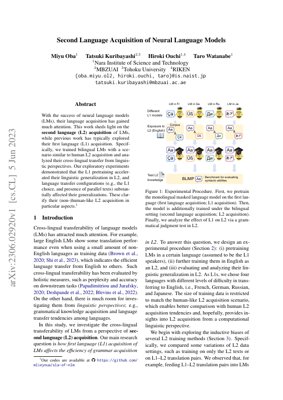
This research investigates the Second Language (L2) acquisition process in Neural Language Models (LMs), shifting focus from the typical study of their First Language (L1) acquisition. The core question is how prior L1 knowledge influences the efficiency and nature of grammatical knowledge acquisition in a new language (L2). The study designs a human-like L2 learning scenario for bilingual LMs, pretraining them on an L1 (French, German, Russian, Japanese) before exposing them to English (L2). The primary evaluation metric is linguistic generalization in L2, assessed through grammatical judgment tests, aiming to clarify the (non-)human-like aspects of LM language transfer.
2. Experimental Procedure & Methodology
The methodology follows a three-stage pipeline designed to mirror human L2 learning:
- L1 Pretraining (First Language Acquisition): A monolingual masked language model (e.g., BERT architecture) is pretrained from scratch on a corpus of a single language (L1).
- L2 Training (Second Language Acquisition): The L1-pretrained model is further trained on English data under controlled, data-limited conditions to simulate resource-constrained L2 learning.
- Evaluation & Analysis: The model's acquired L2 knowledge is probed using the BLiMP benchmark, a suite of tests for evaluating syntactic abilities through grammatical acceptability judgments.
Key controlled variables include the choice of L1 (varying typological distance from English) and the configuration of L2 training data (monolingual vs. parallel texts).
3. Inductive Biases in L2 Training Methods
Initial experiments compared different L2 data settings to understand model inductive biases. A key finding was that training on L1-L2 translation pairs slowed down L2 grammar acquisition compared to training on L2 monolingual texts presented intermittently (e.g., every two epochs). This suggests that for the specific goal of acquiring L2 grammatical structure, direct exposure to L2 patterns is more efficient than learning through explicit translation alignment in this setup, hinting at differences between model and human learning pathways where parallel data might be more beneficial.
4. Effects of L1 Training on L2 Grammar Acquisition
4.1 L1 Knowledge Promotes L2 Generalization
The study found that models with L1 pretraining demonstrated better linguistic generalization in L2 compared to models trained on L2 from scratch with equivalent total data. This indicates that prior linguistic knowledge, even from a different language, provides a beneficial inductive bias for acquiring the structural regularities of a new language.
4.2 L1 Choice Impacts Transfer Efficiency
The typological proximity of L1 to English (L2) significantly affected transfer efficiency. Models with French or German as L1 (Germanic/Romance languages closer to English) achieved better L2 generalization than those with Russian or Japanese (Slavic and Japonic languages, more distant). This aligns with human second language acquisition studies, such as those referenced by Chiswick and Miller (2004), which categorize language transfer difficulty based on linguistic distance.
4.3 Differential Effects on Grammar Types
The benefit from L1 pretraining was not uniform across all grammatical phenomena. Gains were more substantial for morphological and syntactic items (e.g., subject-verb agreement, syntactic islands) compared to semantic and syntax-semantic items (e.g., quantifier scope, coercion). This suggests L1 knowledge primarily bootstraps formal, structural aspects of language rather than meaning-centric or interface phenomena.
5. Process Analysis of L2 Acquisition
5.1 Progression and Data Inefficiency
Analysis of the learning curve revealed that L2 knowledge acquisition in these models is data-inefficient. Significant generalization improvements often required the model to see the entire limited L2 dataset many times (e.g., 50-100 epochs). Furthermore, the process exhibited catastrophic interference or knowledge degradation in the L1 domain during L2 training, highlighting a tension between acquiring new linguistic knowledge and retaining old ones—a challenge also noted in continual learning literature for neural networks.
6. Core Insight & Analyst's Perspective
Core Insight: This paper delivers a crucial, often overlooked truth: modern LMs are not magic multilingual sponges. Their "L2" proficiency is heavily mortgaged by their "L1" upbringing and the architectural debt of their pretraining. The finding that parallel data can hinder syntactic acquisition is a bombshell, directly challenging the industry's default "more data, any data" mantra for multilingual AI. It reveals a fundamental misalignment between the objective of translation (mapping) and the objective of language acquisition (internalizing structure).
Logical Flow: The research logic is admirably clean and psychologically inspired: 1) Establish a linguistic baseline (L1), 2) Introduce a controlled L2 stimulus, 3) Diagnose transfer effects. This mirrors methodologies from human SLA research, allowing for a rare apples-to-apples (though not perfect) comparison between human and machine learning. The use of BLiMP provides a granular, theory-informed lens, moving beyond holistic metrics like perplexity, which often mask nuanced failure modes.
Strengths & Flaws: The strength is its rigorous, constrained experimental design and its focus on linguistic generalization rather than task performance. It asks "what do they learn?" not just "how well do they do?". A major flaw, however, is the scale. Testing smaller models on limited data, while good for control, leaves a giant question mark over whether these findings scale to modern 100B+ parameter models trained on trillion-token corpora. Does the "L1 advantage" plateau or even invert? The catastrophic forgetting of L1 is also under-explored—this isn't just an academic concern but a critical flaw for real-world multilingual systems that must maintain all languages.
Actionable Insights: For AI developers, this is a mandate for strategic pretraining. Don't just think "multilingual"; think "scaffolded multilingual." The choice of base language(s) is a hyperparameter with profound downstream effects. For data curation, the parallel-data slowdown suggests the need for staged training regimens—perhaps monolingual L2 immersion first for syntax, followed by parallel data for semantic alignment. Finally, the field must develop evaluation suites that, like BLiMP, can diagnose how models are multilingual, not just if they are. The quest isn't for a polyglot, but for a coherent multilingual mind inside the machine.
7. Technical Details & Mathematical Framework
The core model is based on the Transformer architecture and the Masked Language Modeling (MLM) objective. During L1 pretraining, the model learns by predicting randomly masked tokens $w_t$ in a sequence $W = (w_1, ..., w_n)$, maximizing the probability: $$P(w_t | W_{\\backslash t}; \\theta)$$ where $\\theta$ are the model parameters and $W_{\\backslash t}$ is the sequence with the token at position $t$ masked.
During L2 acquisition, the model, now with parameters $\\theta_{L1}$ from L1 pretraining, is fine-tuned on L2 data $D_{L2}$ by minimizing the cross-entropy loss: $$\\mathcal{L}_{L2} = -\\sum_{(W) \\in D_{L2}} \\sum_{t \\in M} \\log P(w_t | W_{\\backslash t}; \\theta)$$ where $M$ is the set of masked positions. The central analysis involves comparing the performance of models initialized with $\\theta_{L1}$ versus models initialized randomly ($\\theta_{random}$) after training on $D_{L2}$, measuring the transfer gain $\\Delta G = G(\\theta_{L1}) - G(\\theta_{random})$, where $G$ is accuracy on the BLiMP benchmark.
8. Experimental Results & Chart Interpretation
While the provided PDF excerpt does not contain specific charts, the described results can be conceptualized visually:
- Chart 1: L2 Accuracy vs. L2 Training Epochs for different L1s. This would show four learning curves (Fr, Ge, Ru, Ja). French and German curves would rise more steeply and to a higher final plateau than Russian and Japanese, illustrating the "linguistic distance" effect. All curves would show a long, slow climb, demonstrating data inefficiency.
- Chart 2: Performance Gain from L1 Pretraining by Grammar Type. A bar chart with categories: Morphology, Syntax, Semantics, Syntax-Semantics. The bars for Morphology and Syntax would be significantly taller than those for Semantics and Syntax-Semantics, visually confirming the differential transfer effect.
- Chart 3: L1 Proficiency vs. L2 Training Epochs. A line chart likely showing a declining trend for L1 evaluation accuracy as L2 training progresses, illustrating the phenomenon of catastrophic interference or knowledge degradation in the L1 domain.
The key takeaway from these hypothetical results is that transfer is positive but selective and inefficient, and it comes at a potential cost to previously acquired knowledge.
9. Analysis Framework: A Case Study
Scenario: Analyzing the L2 acquisition of an English (L2) model pretrained on Japanese (L1).
Framework Application:
- Hypothesis: Due to high typological distance (Subject-Object-Verb vs. Subject-Verb-Object word order, complex postpositional particles vs. prepositions), the model will show weaker transfer on English syntactic phenomena, particularly those involving word order (e.g., Anaphor Agreement in BLiMP), compared to a model pretrained on German.
- Probing: After L2 training, administer the relevant BLiMP sub-tests (e.g., "Anaphor Agreement," "Argument Structure," "Binding") to both the Ja->En and De->En models.
- Metric: Calculate the Relative Transfer Efficiency (RTE): $RTE = (Acc_{L1} - Acc_{No-L1}) / Acc_{No-L1}$, where $Acc_{No-L1}$ is the accuracy of a model trained on English from scratch.
- Prediction: The RTE for the Ja->En model on word-order-sensitive syntax tests will be lower than that for the De->En model, and possibly lower than its own RTE on morphological tests (e.g., past tense inflection).
- Interpretation: This case would demonstrate that the inductive bias from L1 is not a general "ability to learn language" but is shaped by the specific structural properties of L1, which can facilitate or hinder the acquisition of specific L2 constructs.
10. Future Applications & Research Directions
- Optimized Multilingual Model Pretraining: Designing curriculum learning strategies where L1s are chosen and ordered based on typological features to optimally scaffold the acquisition of a target set of languages.
- Personalized Language Learning Tools: AI tutors that diagnose a human learner's L1 and predict areas of difficulty in L2 based on model transfer patterns, offering targeted exercises.
- Mitigating Catastrophic Forgetting: Developing continual learning algorithms for LMs that enable stable acquisition of multiple languages without degrading performance in previously learned ones, inspired by elastic weight consolidation or progressive networks.
- Linguistic Typology Discovery: Using the "transfer efficiency" between languages as a quantitative, data-driven metric to augment traditional linguistic typology, potentially revealing novel language families or relationships.
- Low-Resource Language Bootstrapping: Strategically selecting a high-resource "scaffolding language" (L1) that maximally benefits the acquisition of a specific low-resource language (L2), dramatically reducing the data needed for effective model deployment.
11. References
- Oba, M., Kuribayashi, T., Ouchi, H., & Watanabe, T. (2023). Second Language Acquisition of Neural Language Models. arXiv preprint arXiv:2306.02920.
- Chiswick, B. R., & Miller, P. W. (2004). Linguistic Distance: A Quantitative Measure of the Distance Between English and Other Languages. Journal of Multilingual and Multicultural Development.
- Brown, T. B., et al. (2020). Language Models are Few-Shot Learners. Advances in Neural Information Processing Systems.
- Papadimitriou, I., & Jurafsky, D. (2020). Pretraining on Non-English Data Improves English Syntax. Proceedings of the 1st Conference of the Asia-Pacific Chapter of the Association for Computational Linguistics.
- Warstadt, A., et al. (2020). BLiMP: The Benchmark of Linguistic Minimal Pairs. Proceedings of the Society for Computation in Linguistics.
- Kirkpatrick, J., et al. (2017). Overcoming Catastrophic Forgetting in Neural Networks. Proceedings of the National Academy of Sciences. (External source on continual learning).
- Ruder, S. (2021). Challenges and Opportunities in NLP Benchmarking. The Gradient. (External perspective on evaluation).