1. Introduction & Overview
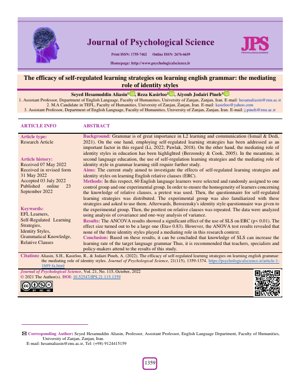
This study examines the efficacy of Self-Regulated Learning (SRL) strategies on the acquisition of English Relative Clauses (ERC), with a specific focus on the potential mediating role of learner identity styles. Grammar, particularly complex syntactic structures like relative clauses, is crucial for second language (L2) proficiency and communicative competence. The research is grounded in the theoretical frameworks of self-regulation in learning (Pintrich, 2004) and identity development (Erikson, 1968; Berzonsky, 2005), positing that how learners manage their learning process and perceive themselves may significantly influence grammatical outcomes.
2. Research Methodology
A quasi-experimental design was employed to investigate the proposed relationships.
2.1 Participants & Design
The study involved 60 Iranian English as a Foreign Language (EFL) learners. Participants were randomly assigned to either an Experimental Group (EG) (n=30), which received training in SRL strategies, or a Control Group (CG) (n=30), which followed conventional instruction. A pretest on relative clauses ensured initial group homogeneity.
2.2 Instruments & Procedure
The procedure followed a structured sequence:
- Pretest: Assessment of baseline ERC knowledge.
- SRL Questionnaire: Administered to all participants to gauge existing strategy use.
- Intervention: The EG received explicit training on SRL strategies (e.g., goal-setting, self-monitoring, self-evaluation) tailored for grammar learning.
- Identity Style Questionnaire (Berzonsky): Administered to the EG to categorize learners into informational, normative, or diffuse-avoidant identity styles.
- Posttest: Repeated assessment of ERC knowledge after the intervention period.
Data analysis utilized Analysis of Covariance (ANCOVA) and one-way Analysis of Variance (ANOVA).
3. Results & Analysis
3.1 Statistical Findings
The ANCOVA results revealed a statistically significant main effect for the SRL strategy intervention on posttest ERC scores, controlling for pretest scores (p < 0.01). This indicates that learners in the experimental group, who were trained in SRL strategies, outperformed those in the control group in learning relative clauses.
Conversely, the ANOVA test results showed that none of the three identity styles (informational, normative, diffuse-avoidant) demonstrated a statistically significant mediating effect on the relationship between SRL use and ERC achievement in this specific context.
3.2 Effect Size Interpretation
The effect size for the SRL intervention was calculated as Eta squared (η²) = 0.83. According to Cohen's conventions (1988), this represents a large effect size, suggesting that knowledge and use of SRL strategies explain a substantial proportion of the variance in grammar learning success, making it a practically significant finding for pedagogy.
Key Result Summary
SRL Effect: Significant (p < 0.01) | Effect Size (η²): 0.83 (Large)
Identity Mediation: Not Significant
4. Discussion & Conclusion
The study conclusively demonstrates that explicit instruction in Self-Regulated Learning strategies significantly enhances the acquisition of complex English grammar, specifically relative clauses. The large effect size underscores the pedagogical potency of empowering learners with metacognitive tools to plan, monitor, and evaluate their learning. The non-significant finding regarding identity styles suggests that, in this study's context, the direct application of learning strategies had a more powerful and immediate impact on performance than broader, dispositional identity factors. The authors recommend that EFL teachers, curriculum designers, and policymakers integrate SRL strategy training into grammar instruction to optimize learning outcomes.
5. Core Insight & Critical Analysis
Core Insight: This research delivers a clear, actionable, and powerful message: teaching learners how to learn grammar is more immediately impactful for specific syntactic acquisition than addressing their broader psychological identity style. The direct effect of SRL strategies is robust and unambiguous.
Logical Flow & A Critical Gap: The study's logic—intervene with SRL, measure outcome, check if identity style explains the variance—is sound. However, the leap from a non-significant mediation result to downplaying the role of identity is potentially premature. As noted in seminal works on language learner identity by Norton and Toohey (2001), identity is not a static mediator but a dynamic, contextually constructed force that can enable or constrain access to learning opportunities and engagement with strategies. The study's design treats identity as a fixed, pre-existing filter, potentially missing how the act of successfully using SRL strategies might itself reshape a learner's identity as a capable language user—a process highlighted in Dörnyei's (2009) L2 Motivational Self System. The null result may reflect a measurement/modeling issue, not the irrelevance of identity.
Strengths & Flaws: The study's strength lies in its clean experimental design, clear operationalization of SRL, and a large, meaningful effect size that directly informs practice—a rarity in applied linguistics. The flaw, as argued, is a somewhat reductionist view of identity. Comparing it to a breakthrough in AI like CycleGAN (Zhu et al., 2017), which learns to translate between domains without paired examples, this study successfully "translates" SRL training into grammar gains. Yet, like early AI that ignored context, it may overlook the "domain" of the learner's social-psychological ecosystem where identity operates.
Actionable Insights: For practitioners: Immediately implement SRL strategy training for grammar. It works. For researchers: Do not abandon identity. Instead, design longitudinal, qualitative, or complex dynamic systems studies to explore how SRL strategy use and grammatical success co-evolve with and actively shape learner identity over time. Use methods from the Douglas Fir Group's (2016) transdisciplinary framework to capture the multi-layered influences.
6. Technical Framework & Mathematical Model
The core analysis can be represented by a mediation model tested via ANCOVA and ANOVA. The primary ANCOVA model to assess the SRL intervention effect is:
$Y_{post, i} = \beta_0 + \beta_1 (Group_i) + \beta_2 (Y_{pre, i}) + \epsilon_i$
Where $Y_{post}$ is the posttest score, $Group$ is a dummy variable (0=Control, 1=Experimental), $Y_{pre}$ is the pretest score (covariate), and $\epsilon$ is the error term. A significant $\beta_1$ indicates the treatment effect.
The mediation analysis for identity style (M) on the path between SRL (X) and ERC (Y) follows Baron & Kenny's (1986) logic, tested via separate ANOVAs/regressions within the experimental group:
- Path a: Effect of X on M. (Was identity style influenced by being in the SRL group? Not tested directly here).
- Path b: Effect of M on Y, controlling for X. Tested via ANOVA on posttest scores with Identity Style as a factor.
- The non-significant result for Path b led to the conclusion of no mediation.
The effect size, Partial Eta Squared ($\eta_p^2$), is calculated as: $\eta_p^2 = \frac{SS_{effect}}{SS_{effect} + SS_{error}}$ for the given effect in the ANCOVA.
7. Experimental Results & Visualization
The key results can be visualized through two primary charts:
Chart 1: Pre-test vs. Post-test Score Comparison (EG vs. CG)
A clustered bar chart showing mean scores for both groups at pre-test and post-test. The bars for the Experimental Group at post-test would be substantially higher than all others, visually demonstrating the large treatment effect. The Control Group's post-test bar would show only marginal growth from its pre-test.
Chart 2: Post-test Scores by Identity Style (Experimental Group Only)
A bar chart showing the mean post-test score for learners categorized into Informational, Normative, and Diffuse-Avoidant identity styles within the EG. The bars would likely show minor, non-significant differences in height, visually confirming the ANOVA result that identity style did not systematically relate to outcome in this sample after the SRL intervention.
Interpretation: The visual narrative is clear: the SRL "treatment" elevates the entire EG, creating a stark between-groups difference. Within that elevated EG, identity style does not create further clear stratification in performance.
8. Analysis Framework: Case Example
Scenario: An EFL teacher, Ms. Chen, wants to apply this research in her intermediate-level class struggling with adjective clauses.
Framework Application:
- Diagnosis (Pre-test): Ms. Chen administers a short diagnostic test on adjective clauses to establish a baseline.
- Strategy Toolbox (Intervention): Instead of just explaining grammar rules, she dedicates 15 minutes per lesson for 2 weeks to SRL strategy training:
- Planning: "By the end of this week, I will be able to identify the noun being modified in 5 practice sentences."
- Monitoring: Teaching self-questioning: "Did I use 'who' for people and 'which' for things?" "Does this clause need a subject pronoun?"
- Evaluation: Using a simple checklist for peer-review exercises: "1. Correct relative pronoun? 2. Clause placed correctly? 3. Meaning clear?"
- Guided Practice: Students complete exercises while "thinking aloud" about their strategy use.
- Assessment & Reflection (Post-test): A new adjective clause test is given. Ms. Chen also asks students to write a short reflection on which strategy helped most, linking performance to process.
Expected Outcome: Following the study's findings, Ms. Chen can expect a significant overall improvement in the class's accuracy with adjective clauses, with the gains primarily attributed to the strategic toolkit provided, rather than trying to profile and cater to different student identity types for this specific skill.
9. Future Applications & Research Directions
- Technology-Enhanced SRL: Developing adaptive learning apps (akin to platforms like Duolingo but strategy-focused) that scaffold planning, monitoring, and evaluation for grammar points. These could use algorithms to prompt strategy use at optimal moments.
- Micro-Longitudinal Studies: Using experience sampling methods (ESM) or learning analytics dashboards to track the fluctuation of SRL strategy use, momentary identity perceptions (e.g., "I feel like a competent learner right now"), and micro-level grammar practice success over days or weeks, capturing dynamics missed in pre-post designs.
- Cross-linguistic Generalization: Testing if the powerful effect of SRL on ERC holds for learning other complex grammatical structures (e.g., subjunctive mood, passive voice) in English or in other languages with different syntactic properties.
- Integrating with Motivational Theories: Merging SRL training with interventions from Self-Determination Theory (autonomy, competence, relatedness) or the L2 Motivational Self System to create a more holistic "learning to learn" package that may indirectly influence identity in a measurable way.
- Teacher Training Modules: Creating professional development resources based on this study's evidence to help teachers effectively integrate metacognitive strategy instruction into standard grammar curricula.
10. References
- Aliasin, S. H., Kasirloo, R., & Jodairi Pineh, A. (2022). The efficacy of self-regulated learning strategies on learning english grammar: the mediating role of identity styles. Journal of Psychological Science, 21(115), 1359-1374.
- Baron, R. M., & Kenny, D. A. (1986). The moderator–mediator variable distinction in social psychological research: Conceptual, strategic, and statistical considerations. Journal of Personality and Social Psychology, 51(6), 1173–1182.
- Berzonsky, M. D. (2005). Ego identity: A personal standpoint in a postmodern world. Identity, 5(2), 125-136.
- Cohen, J. (1988). Statistical power analysis for the behavioral sciences (2nd ed.). Lawrence Erlbaum Associates.
- The Douglas Fir Group. (2016). A transdisciplinary framework for SLA in a multilingual world. Modern Language Journal, 100(S1), 19-47.
- Dörnyei, Z. (2009). The L2 Motivational Self System. In Z. Dörnyei & E. Ushioda (Eds.), Motivation, language identity and the L2 self (pp. 9-42). Multilingual Matters.
- Norton, B., & Toohey, K. (2001). Changing perspectives on good language learners. TESOL Quarterly, 35(2), 307-322.
- Pintrich, P. R. (2004). A conceptual framework for assessing motivation and self-regulated learning in college students. Educational Psychology Review, 16(4), 385-407.
- Zhu, J. Y., Park, T., Isola, P., & Efros, A. A. (2017). Unpaired image-to-image translation using cycle-consistent adversarial networks. Proceedings of the IEEE International Conference on Computer Vision (pp. 2223-2232).