Table of Contents
1. Introduction & Overview
Reading Comprehension (RC) is a fundamental challenge in Natural Language Processing (NLP), requiring machines to understand text and answer questions about it. The 2016 paper "SQuAD: 100,000+ Questions for Machine Comprehension of Text" by Rajpurkar et al. from Stanford University introduced a landmark dataset to address the lack of large-scale, high-quality resources for this task. Prior to SQuAD, RC datasets were either too small for modern data-driven models or were semi-synthetic, lacking the nuance of human-generated questions. SQuAD filled this critical gap, providing over 100,000 question-answer pairs based on Wikipedia articles, where each answer is a contiguous text span from the corresponding passage. This format created a well-defined, yet challenging, benchmark that has since driven immense progress in NLP.
Dataset at a Glance
- 107,785 Question-Answer Pairs
- 536 Wikipedia Articles
- ~2 orders of magnitude larger than previous datasets (e.g., MCTest)
- Answer Format: Text Span from the passage
2. The SQuAD Dataset
2.1 Dataset Construction & Scale
SQuAD was created using crowdworkers who read Wikipedia passages and formulated questions for which the answer was a segment of text within that passage. This methodology ensured the questions were natural and diverse, reflecting genuine human curiosity and comprehension challenges. With 107,785 QA pairs, it significantly outperformed the scale of predecessors like MCTest (Richardson et al., 2013), enabling the training of more complex neural models.
2.2 Key Characteristics & Answer Format
The defining characteristic of SQuAD is its span-based answer format. Unlike multiple-choice questions, systems must identify the exact start and end indices of the answer within the passage. This eliminates the cueing effect of answer choices and forces models to perform genuine text understanding and evidence localization. The paper notes that while this is more constrained than open-ended interpretive questions, it allows for precise evaluation and still encompasses a rich diversity of question types.
3. Methodology & Analysis
3.1 Question Difficulty & Reasoning Types
The authors employed linguistic analysis, using dependency and constituency trees, to categorize questions by difficulty and the type of reasoning required. They measured the syntactic divergence between the question and the answer sentence, and categorized answer types (e.g., Person, Location, Date). This analysis provided a nuanced view of the dataset's challenges, showing that performance degraded with increased syntactic complexity and certain answer types.
3.2 Baseline Model: Logistic Regression
To establish a baseline, the authors implemented a logistic regression model. This model used a combination of features, including lexical overlap (word matching) and features derived from dependency tree paths connecting question words to candidate answer spans. The choice of a strong linear model served as a transparent and interpretable benchmark against which more complex neural models could be compared.
4. Experimental Results
4.1 Performance Metrics (F1 Score)
The primary evaluation metric was the F1 score, which balances precision (the proportion of predicted answer tokens that are correct) and recall (the proportion of true answer tokens that are predicted). The logistic regression baseline achieved an F1 score of 51.0%, a substantial improvement over a simple word-matching baseline (20%).
4.2 Human vs. Machine Performance Gap
A critical finding was the large performance gap between machine and human. Crowdworkers achieved an F1 score of 86.8% on the evaluation set. This 35.8-point gap clearly demonstrated that SQuAD presented a "good challenge problem" far from being solved, thus setting a clear and compelling research target for the community.
5. Core Insight & Analyst Perspective
Core Insight: The SQuAD paper wasn't just about releasing data; it was a masterclass in benchmark engineering. The authors correctly identified that the field's progress was bottlenecked by data quality and scale, mirroring the pivotal role ImageNet played in computer vision. By creating a task that was difficult yet precisely measurable (span-based answers), they built a runway for the deep learning revolution in NLP.
Logical Flow: The paper's logic is impeccable: 1) Diagnose the field's data problem (small or synthetic datasets), 2) Propose a solution with specific, advantageous constraints (span-based QA on Wikipedia), 3) Rigorously analyze the new dataset's properties, 4) Establish a strong, interpretable baseline to calibrate difficulty, and 5) Highlight the sizable human-machine gap to motivate future work. This blueprint has been emulated in countless subsequent benchmark papers.
Strengths & Flaws: Its greatest strength is its catalytic effect. SQuAD directly enabled the rapid iteration and comparison of models like BiDAF, QANet, and the early versions of BERT, creating a clear leaderboard that drove innovation. However, its flaw, acknowledged even by its creators and later critics, is the span-based limitation. Real-world comprehension often requires synthesis, inference, or multi-span answers. This led to the creation of more complex successors like SQuAD 2.0 (including unanswerable questions) and datasets like HotpotQA (multi-hop reasoning). As noted in the "Natural Questions" paper (Kwiatkowski et al., 2019), real user questions often don't have a verbatim span answer, pushing the field beyond SQuAD's original paradigm.
Actionable Insights: For practitioners and researchers, the lesson is twofold. First, the value of a well-constructed benchmark is immeasurable—it defines the playing field. Second, SQuAD teaches us to be wary of "benchmark overfitting." Models that excel on SQuAD's F1 score may not generalize to more realistic, messy QA settings. The future, as seen in the work of the Allen Institute for AI on datasets like DROP (discrete reasoning) or the push towards open-domain QA, lies in tasks that better approximate the complexity and ambiguity of human language understanding. SQuAD was the essential first major step on that path, proving that large-scale, high-quality data is the non-negotiable fuel for AI progress, a principle as true today with large language models as it was in 2016.
6. Technical Details
6.1 Mathematical Formulation
The span selection task can be framed as predicting the start index $i$ and end index $j$ of the answer span within a passage $P$ of length $n$, given a question $Q$. The baseline logistic regression model scores each candidate span $(i, j)$ using a feature vector $\phi(P, Q, i, j)$:
$\text{score}(i, j) = \mathbf{w}^T \phi(P, Q, i, j)$
The model then selects the span with the highest score. The probability of a span being the correct answer can be modeled using the softmax function over all possible spans:
$P((i, j) | P, Q) = \frac{\exp(\text{score}(i, j))}{\sum_{i', j'} \exp(\text{score}(i', j'))}$
6.2 Feature Engineering
The feature set $\phi$ included:
- Lexical Features: Term frequency (TF) and inverse document frequency (IDF) matches between question and passage words.
- Syntactic Features: Features based on dependency parse tree paths linking question words (like "what," "causes") to candidate answer words in the passage.
- Span Features: Length of the candidate span, its position in the passage.
7. Analysis Framework: Example Case
Case Study: Analyzing the "Precipitation" Passage
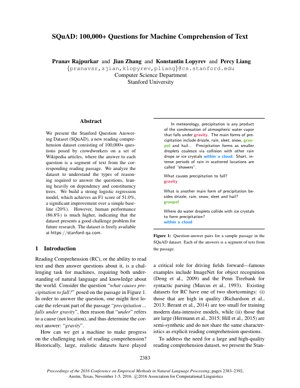
Consider the example from Figure 1 of the paper:
- Passage Snippet: "...precipitation... falls under gravity."
- Question: "What causes precipitation to fall?"
- Gold Answer Span: "gravity"
Analysis Framework Steps:
- Candidate Span Generation: Enumerate all possible contiguous word sequences in the passage (e.g., "precipitation", "falls", "under", "gravity", "falls under", "under gravity", etc.).
- Feature Extraction: For the candidate span "gravity", extract features:
- Lexical Match: The word "causes" in the question may weakly align with the causal implication of "under" in "falls under gravity".
- Dependency Path: In the dependency tree, the path from the question root ("causes") to the answer word ("gravity") might traverse a prepositional modifier ("under"), indicating a causal relationship.
- Span Length: 1 (a single word).
- Model Scoring: The logistic regression model weights these features. The dependency path feature indicating a causal link would likely receive high positive weight, leading to a high score for the span "gravity".
- Prediction & Evaluation: The model selects "gravity" as the predicted answer. An exact match with the gold span results in a perfect score for this example.
This case illustrates how even a linear model, when equipped with meaningful syntactic features, can perform non-trivial reasoning to locate the correct answer.
8. Future Applications & Directions
The SQuAD dataset and the research it inspired laid the groundwork for numerous advancements:
- Pre-training & Transfer Learning: SQuAD became a key benchmark for evaluating pre-trained language models like BERT, GPT, and T5. Success on SQuAD demonstrated a model's general language understanding capabilities, which could then be transferred to other downstream tasks.
- Beyond Span Extraction: The limitations of span-based QA spurred research into more complex formulations:
- Multi-hop QA: Requiring reasoning across multiple documents or passages (e.g., HotpotQA).
- Free-form/Generative QA: Where answers are generated, not extracted (e.g., MS MARCO).
- Unanswerable Questions: Handling questions with no answer in the text (SQuAD 2.0).
- Real-World Systems: The core technology developed for SQuAD powers modern search engines' question-answering features, chatbots, and intelligent document analysis tools.
- Explainable AI (XAI): The need to understand why a model selects a particular span has driven research into attention visualization and model interpretability techniques in NLP.
The future direction, as evidenced by models like OpenAI's ChatGPT, is moving towards open-domain, conversational, and generative QA, where the model must retrieve relevant knowledge, reason over it, and articulate a coherent, natural language response—a paradigm that builds directly upon the foundational reading comprehension skills honed on datasets like SQuAD.
9. References
- Rajpurkar, P., Zhang, J., Lopyrev, K., & Liang, P. (2016). SQuAD: 100,000+ Questions for Machine Comprehension of Text. Proceedings of the 2016 Conference on Empirical Methods in Natural Language Processing (EMNLP), 2383–2392.
- Deng, J., Dong, W., Socher, R., Li, L. J., Li, K., & Fei-Fei, L. (2009). ImageNet: A large-scale hierarchical image database. 2009 IEEE Conference on Computer Vision and Pattern Recognition.
- Marcus, M. P., Marcinkiewicz, M. A., & Santorini, B. (1993). Building a large annotated corpus of English: The Penn Treebank. Computational linguistics, 19(2), 313-330.
- Richardson, M., Burges, C. J., & Renshaw, E. (2013). MCTest: A Challenge Dataset for the Open-Domain Machine Comprehension of Text. Proceedings of the 2013 Conference on Empirical Methods in Natural Language Processing (EMNLP).
- Hermann, K. M., Kocisky, T., Grefenstette, E., Espeholt, L., Kay, W., Suleyman, M., & Blunsom, P. (2015). Teaching Machines to Read and Comprehend. Advances in Neural Information Processing Systems (NeurIPS).
- Kwiatkowski, T., Palomaki, J., Redfield, O., Collins, M., Parikh, A., Alberti, C., ... & Petrov, S. (2019). Natural Questions: a Benchmark for Question Answering Research. Transactions of the Association for Computational Linguistics, 7, 452-466.
- Devlin, J., Chang, M. W., Lee, K., & Toutanova, K. (2019). BERT: Pre-training of Deep Bidirectional Transformers for Language Understanding. Proceedings of the 2019 Conference of the North American Chapter of the Association for Computational Linguistics: Human Language Technologies (NAACL-HLT).