Table of Contents
- 1. Introduction
- 2. The Background Paradox
- 3. Daneman & Carpenter's Resolution
- 4. Meta-Analysis Methodology
- 5. Results & Key Findings
- 6. Technical Details & Formulas
- 7. Experimental Results & Diagrams
- 8. Analysis Framework Example
- 9. Original Analysis & Expert Commentary
- 10. Future Applications & Directions
- 11. References
1. Introduction
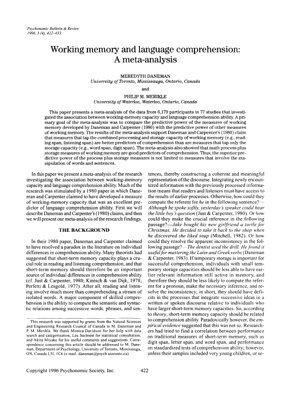
This paper presents a comprehensive meta-analysis of 77 studies involving 6,179 participants, investigating the association between working-memory capacity and language comprehension ability. The primary goal is to compare the predictive power of Daneman and Carpenter's (1980) processing-plus-storage measures (e.g., reading span, listening span) against traditional storage-only measures (e.g., word span, digit span).
2. The Background Paradox
2.1 The Role of Short-Term Memory
Theorists like Just & Carpenter (1980) and Kintsch & van Dijk (1978) argued that short-term memory is crucial for integrating successive words, phrases, and sentences during reading and listening. For example, resolving pronoun references or making inferences requires temporary storage of earlier information.
2.2 The Empirical Failure
Despite theoretical predictions, traditional measures of short-term memory (digit span, word span) showed very weak correlations with comprehension tests, except in very young children or severely disabled readers. This created a paradox: theory demanded a relationship, but data did not support it.
3. Daneman & Carpenter's Resolution
3.1 The Processing + Storage Model
Daneman and Carpenter (1980) argued that the paradox arose because traditional measures only tap storage capacity, ignoring the simultaneous processing demands of real comprehension. They proposed that working memory is a combined processing-and-storage system.
3.2 The Reading Span Measure
They developed the reading span task, where participants read aloud a series of sentences and then recall the last word of each sentence. This task requires both processing (reading) and storage (remembering words), mimicking the dual demands of comprehension.
4. Meta-Analysis Methodology
4.1 Data Collection
The meta-analysis included 77 studies with a total of 6,179 participants. Studies were categorized by the type of working memory measure used: process-plus-storage (e.g., reading span, listening span, math span) vs. storage-only (e.g., word span, digit span).
4.2 Statistical Approach
Effect sizes (correlation coefficients) were extracted and transformed using Fisher's z-transformation. A random-effects model was used to account for variability across studies. The primary outcome was the correlation between working memory measures and comprehension tests.
5. Results & Key Findings
5.1 Predictive Power Comparison
The meta-analysis confirmed that process-plus-storage measures (mean r = .41) are significantly better predictors of comprehension than storage-only measures (mean r = .28). This supports Daneman and Carpenter's claim. Furthermore, math process-plus-storage measures also showed strong predictive power (mean r = .39), indicating the effect is not limited to verbal tasks.
5.2 Statistical Card
Key Statistics:
- Total participants: 6,179
- Number of studies: 77
- Mean correlation (process+storage): r = .41
- Mean correlation (storage-only): r = .28
- Mean correlation (math process+storage): r = .39
6. Technical Details & Formulas
The meta-analysis used the following formula for Fisher's z-transformation:
$z = \frac{1}{2} \ln\left(\frac{1+r}{1-r}\right)$
Where $r$ is the correlation coefficient. The combined effect size was then calculated using a weighted average of the z-scores, with weights inversely proportional to the variance.
7. Experimental Results & Diagrams
The results are best visualized in a forest plot showing individual study effect sizes and the overall combined effect. The plot would show that process-plus-storage measures consistently yield higher correlations with comprehension than storage-only measures. A funnel plot would also be used to assess publication bias, showing a symmetric distribution around the mean effect size.
8. Analysis Framework Example
Consider a hypothetical study comparing reading span and digit span as predictors of reading comprehension. The reading span task involves reading sentences and recalling final words, while digit span involves recalling a sequence of digits. The meta-analysis framework would extract the correlation between each measure and a standardized comprehension test (e.g., Nelson-Denny). The expected outcome is that reading span shows a significantly higher correlation (e.g., r = .45) than digit span (e.g., r = .25).
9. Original Analysis & Expert Commentary
Core Insight: This meta-analysis is a landmark validation of the processing-plus-storage model of working memory. It decisively shows that the way we measure cognitive capacity matters more than the capacity itself.
Logical Flow: The authors start with a clear paradox, propose a refined theoretical model, and then use rigorous meta-analytic techniques to test it. The flow is logical and compelling.
Strengths & Flaws: The strength is the large sample size and clear categorization of measures. However, the meta-analysis is limited by the heterogeneity of comprehension tests used across studies. Also, the reliance on correlational data limits causal inference.
Actionable Insights: For researchers, this means that future studies should prioritize process-plus-storage measures like reading span. For educators, it suggests that training programs should focus on simultaneous processing and storage, not just rote memory. As noted by Baddeley (2003) in his review of working memory, the central executive component is critical for complex cognition. This meta-analysis provides strong empirical support for that view.
10. Future Applications & Directions
Future research should explore the neural basis of processing-plus-storage measures using fMRI. Additionally, adaptive training programs that combine processing and storage demands could be developed for educational interventions. The findings also have implications for AI models of language comprehension, where a similar dual-task architecture could improve performance.
11. References
- Daneman, M., & Carpenter, P. A. (1980). Individual differences in working memory and reading. Journal of Verbal Learning and Verbal Behavior, 19(4), 450-466.
- Just, M. A., & Carpenter, P. A. (1980). A theory of reading: From eye fixations to comprehension. Psychological Review, 87(4), 329-354.
- Kintsch, W., & van Dijk, T. A. (1978). Toward a model of text comprehension and production. Psychological Review, 85(5), 363-394.
- Baddeley, A. (2003). Working memory: Looking back and looking forward. Nature Reviews Neuroscience, 4(10), 829-839.
- Perfetti, C. A., & Lesgold, A. M. (1977). Discourse comprehension and sources of individual differences. In M. A. Just & P. A. Carpenter (Eds.), Cognitive processes in comprehension (pp. 141-183). Hillsdale, NJ: Erlbaum.